
How to Grow Export Quality Vegetables Using the Right Seeds
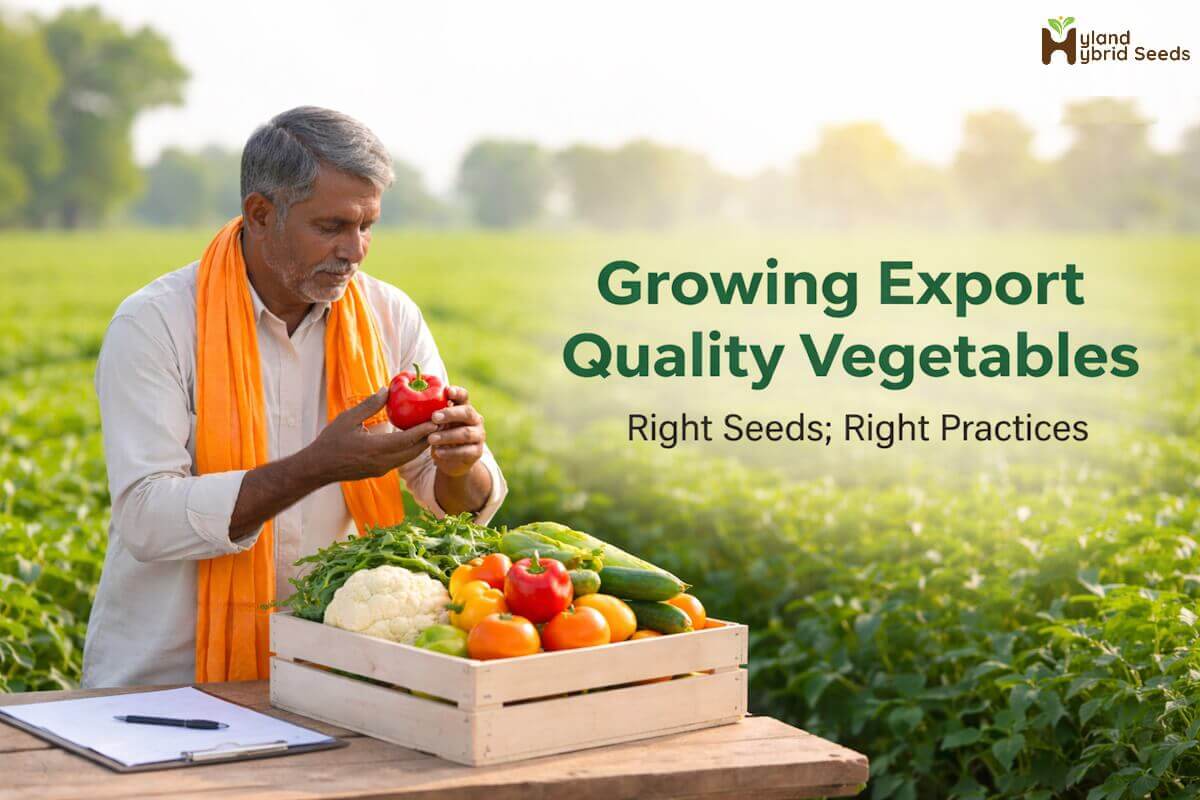
If you are planning to grow export quality vegetables, the first question is not about yield. It is about rejection.
Export markets reject produce for size variation, residue levels, appearance, and shelf life. One rejected consignment can wipe out the profit of a whole season.
Before you choose any seed, ask yourself: can my soil, climate, and management level produce uniform, clean vegetables again and again?
If you are unsure, talk to someone who understands both your farm and export standards.
Not sure if your soil and climate can support export quality vegetables?
What “Export Quality Vegetables” Means on Your Farm
This matters because export buyers do not grade like local markets. They buy by standard, not by story. If your lot is uneven, you lose price, or you lose the order.
Export quality vegetables are not just big or shiny. They must meet:
- Uniform size and shape
- Consistent color
- Low pesticide residue
- Good shelf life (travel durability)
- Minimal mechanical damage
For crops like tomato, okra, chili, cucumber, gourds, onion, and capsicum, buyers demand grading consistency. If 20% of your harvest falls outside size standards, you lose pricing power.
The seed you choose affects fruit uniformity, skin thickness, shelf life, and tolerance to common diseases. Still, seed alone cannot fix weak soil or irregular irrigation.
Start With Your Soil, Not the Seed Packet
This matters because most quality problems start below the plant. Uneven fertility, poor drainage, or salty patches show up as uneven size, weak color, and more disease.
Many farmers rush to buy what they hear is the “best vegetables seeds” in the market. A seed that performs in one soil type can struggle badly in another.
Check These Before You Decide
- Soil type: sandy, loamy, clay, black soil
- Drainage condition
- Organic carbon level
- Salinity issues
- History of nematode or wilt problems
Export quality needs uniform growth. Uneven soil fertility leads to size variation, and that leads to rejection.
- Heavy soil with poor drainage: avoid varieties that suffer in root rot conditions
- Sandy, low fertility soil: look for varieties known for strong roots and steady setting
- Saline patches: avoid sensitive types and fix water and soil first
Seed choice must match soil behavior. Not the other way around.
Climate and Season Are the Real Risk
This matters because export contracts do not adjust for your heat, rain, or wind. Your crop still has to meet grade even when the season turns rough.
Ask yourself:
- Is this crop suited for my temperature range?
- Will fruit set during peak heat?
- Can it tolerate unexpected rain during flowering?
Field reality examples you have probably seen:
- Tomato can drop flowers in high heat spells
- Okra can handle heat but suffers in continuous rainfall
- Capsicum needs steadier weather for uniform fruit shape
If you grow in rain-fed conditions, be careful with high-cost hybrid seeds that demand tight water control. Under irrigation, you have more control, but water quality still matters. Hard water and salty water raise stress and reduce quality.
Choosing Seeds: Stability Beats Hype
This matters because export grading punishes inconsistency. A variety that looks great on one plot and fails on the next can cost you more than it earns.
The phrase “best vegetables seeds” gets used loosely. What is best for one belt can fail in another. When choosing seed for export-focused production, check these points and ask for real answers.
1) Uniformity
Does the variety give similar fruit size and weight across the field? Uniformity reduces grading loss.
2) Disease Tolerance
Look for tolerance to the problems you actually face in your area and soil history, such as:
- Bacterial wilt
- Fusarium wilt
- Powdery mildew
- Downy mildew
- Leaf curl type virus pressure
Disease is not only yield loss. It also damages appearance and shelf life.
3) Crop Duration
Short duration crops reduce exposure to surprise weather. Longer crops can give more, but they face more swings across the season.
4) Shelf Life and Transport Strength
Export vegetables often travel for days. Thin skin and weak firmness mean more damage. Ask your vegetable seeds supplier how the variety behaves after harvest and during transport. Do not accept only yield talk.
If you are unsure whether a hybrid fits your soil and season, clear it now, before spending big on inputs.
Rain-Fed vs Irrigated: Be Straight With Your Setup
This matters because export quality is tied to steady growth. Water swings create cracks, bitterness, poor shape, and uneven size.
Inconsistent moisture can lead to:
- Fruit cracking (common in tomato)
- Bitter taste (seen in cucurbits)
- Curved or uneven pods (in beans and okra)
- Blossom end rot issues where calcium movement suffers
If You Depend Mainly on Rain
- Choose crops that tolerate moisture fluctuation
- Avoid very input-heavy, sensitive hybrids
- Keep plant population sensible so stress does not explode
If You Have Drip or Reliable Irrigation
- Keep soil moisture more even
- Lower stress and reduce some disease pressure
- Manage fertilizer in smaller, steadier splits
Export quality demands control. If your farm cannot provide it yet, change the crop plan or reduce the export portion until you can.
Not sure which vegetable seeds suit your irrigation setup?
Yield Stability Matters More Than Peak Yield
This matters because export farming is a money game with tight margins. A variety that gives a big crop once and collapses next season is not a safe base.
For export planning, stable yield matters more than a record harvest.
Typical yield ranges under good management (ranges only, not promises):
- Tomato: 18–35 tons per acre
- Okra: 4–8 tons per acre
- Cucumber (open field): 8–15 tons per acre
- Capsicum: 12–25 tons per acre
Results vary with soil fertility, temperature swings, pest load, plant population, and timing. Do not buy seed based on someone’s “highest” number. Ask how it performs across seasons.
Input Cost Planning: Count Before You Plant
This matters because export-grade farming usually needs more discipline and more cost. If you start without counting, you can end the season with good yield and weak profit.
Export vegetables often need:
- Higher-cost seed (many are hybrids)
- Regular scouting and timely sprays
- Grading labor
- Packaging material
- Transport and handling
Input cost can be 20–40% higher than local market growing, depending on crop and season.
Ask yourself:
- Do I have reliable labor for picking and grading?
- Can I manage spray timing to meet residue rules?
- Is there a buyer and payment clarity?
Without market linkage, export-focused production raises risk. Do not build a high-cost crop on a vague market.
Pest Control and Residue: The Silent Deal Breaker
This matters because export buyers test residue. Your crop can look perfect and still get rejected if residue is out of range.
This changes your approach:
- Spray timing must be disciplined
- Pre-harvest intervals must be followed
- Random chemical mixing increases risk
A safer field approach is integrated management:
- Sticky traps and regular scouting
- Crop rotation where possible
- Resistant varieties where pressure is known
- Targeted sprays only when needed
If you want help checking a crop plan and keeping residue risk under control, talk before the crop is half grown.
Where Farmers Usually Lose Money in Export Vegetables
This matters because most losses are predictable. They come from avoidable decisions made early, not from bad luck alone.
- Choosing seed based on push, not soil match
- Ignoring drainage issues
- Overcrowding plants to chase yield
- Weak grading discipline at harvest
- No backup plan if the buyer delays or rejects
Export farming rewards planning and punishes shortcuts. Even small mistakes show up in grade.
Who Should Avoid Export-Focused Vegetable Growing
This matters because not every farm setup fits export standards. If you force it, you take high cost with low control.
You should avoid export-oriented vegetable production if:
- You depend fully on uncertain rainfall
- You do not have irrigation control
- Your soil has heavy disease history you cannot manage yet
- You cannot keep strict spray intervals
- You do not have buyer clarity
In these cases, local market production can be safer until you improve control on the farm. There is no shame in choosing stability.
Working With a Vegetable Seeds Supplier: What to Ask
This matters because seed decisions can lock your season. A good vegetable seeds supplier should talk like a field person, not like a poster.
Do not ask only the price. Ask:
- Where has this variety performed well?
- What soil types suit it?
- What is the best planting window for my season?
- Which diseases does it tolerate in real fields?
- How does it behave under heat, rain, and stress?
If answers sound like pure sales talk, be cautious. You are the one taking the risk, not the seller.
Season Planning: Match Crop to Weather, Not Pressure
This matters because the same variety can behave very differently across summer, monsoon, and winter. Export grading does not care why quality dropped.
Summer
- Heat-tolerant choices matter
- Strong disease tolerance helps in stressed crops
- Water planning must be tight
Monsoon
- Drainage is non-negotiable
- Fungal disease pressure rises
- Pick tolerant types and plan sprays carefully
Winter
- Often better quality potential
- Pest pressure can reduce in many areas
- Fog and humidity can still trigger disease
Match crop and seed to season. Not to market noise.
Decision Close: What to Check Before You Buy Seed
This matters because once you plant, you cannot change seed. You can only spend more trying to fix problems.
Before buying, ask yourself:
- Can my soil support uniform growth?
- Can I control water well enough?
- Can I manage pests without breaking residue rules?
- Do I have grading labor and discipline?
- Do I have market clarity, or am I guessing?
If most answers are yes, growing export quality vegetables can give better and steadier returns. If several answers are no, fix the weak points first, or keep export as a smaller portion until you build control.
Your land, your climate, your investment — get guidance that matches all three.
FAQs
What makes vegetables suitable for export quality?
Are hybrid seeds required for export quality vegetables?
Can small farmers grow export quality vegetables?
How do I choose the best vegetables seeds for my region?