
A Guide on Wheat Crop Duration from Sowing to Harvest
Want expert help selecting the right wheat seeds for your area?
Contact UsWhat Is the Average Wheat Crop Duration?
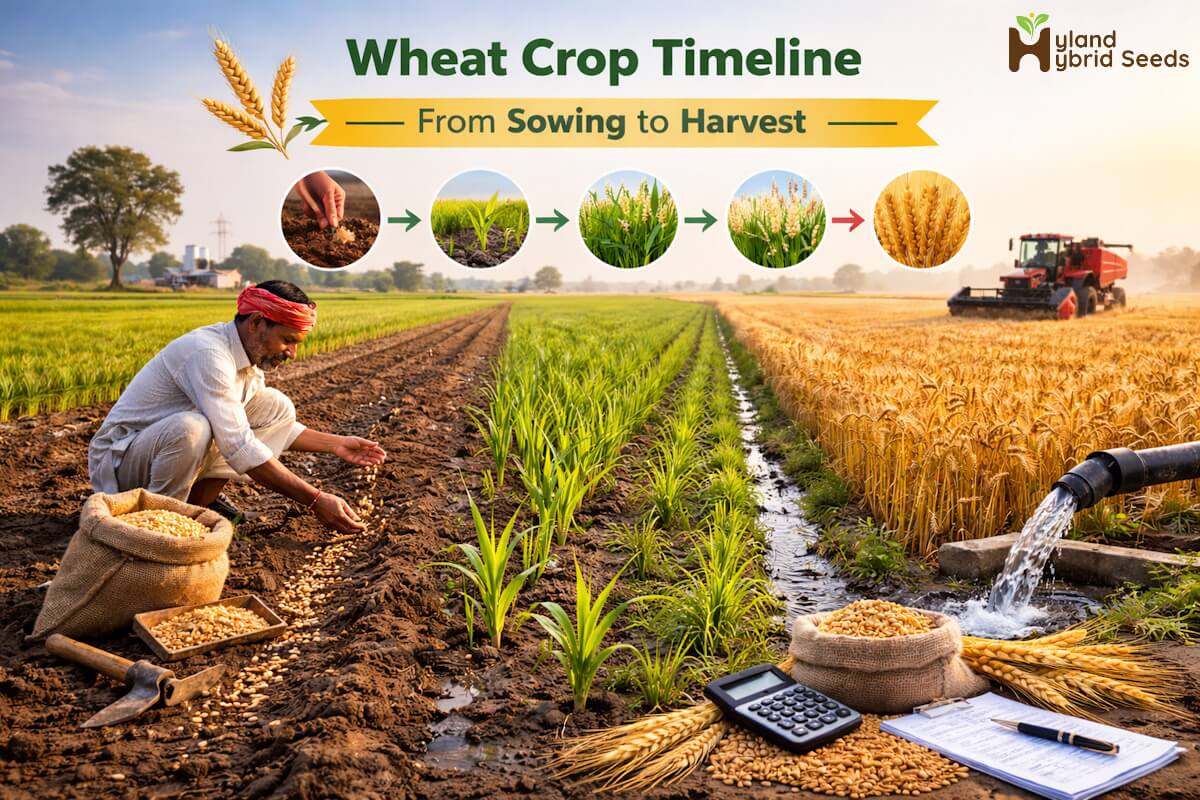
In India, wheat crop duration usually ranges between 110 to 150 days, depending on the variety and region. In northern states like Punjab, Haryana, and Uttar Pradesh, wheat is generally sown from late October to December and harvested between March and April. In cooler countries such as Canada or parts of the USA, the duration may vary based on whether farmers grow spring or winter wheat. Winter wheat takes longer because it is planted in fall and harvested in early summer. Spring wheat follows a shorter cycle. The key point is simple. Wheat crop duration depends on climate, variety, soil fertility, and sowing time. You cannot control the weather, but you can control your planning.Stage 1: Selecting the Right Wheat Seeds
Everything begins with wheat seeds. Poor seed quality can delay germination, reduce plant population, and affect maturity timing. Good seeds give you uniform growth from day one. Indian farmers often choose varieties based on local climate and irrigation availability. Early-maturing varieties are preferred in areas where late heat can damage crops. In irrigated regions, slightly longer-duration varieties may offer better yield. It is always wise to work with a trusted wheat seeds supplier who understands your local conditions. Ask about germination percentage. Ask about disease resistance. Ask how the variety performed last season. These small questions can protect your investment. Wholesalers and distributors also benefit from understanding wheat crop duration. When you know which varieties mature early or late, you can guide farmers better and manage stock more smartly.Stage 2: Sowing and Germination
After selecting wheat seeds, proper sowing becomes the next critical step. In India, the ideal sowing time for most regions is between mid October and mid November. Late sowing often reduces yield because rising temperatures during grain filling can stress the crop. Seeds are usually sown 4 to 5 cm deep. Proper spacing ensures good plant population. Soil moisture must be adequate at the time of sowing. Germination typically takes 5 to 10 days. During this stage, seeds absorb moisture and start root and shoot development. Uniform germination leads to uniform crop growth. Uneven stands create problems later, especially during harvesting. This early phase may seem small, but it sets the rhythm for the entire wheat crop duration.Stage 3: Tillering Phase
Around 20 to 30 days after sowing, the crop enters the tillering stage. Tillers are side shoots that grow from the base of the plant. Each productive tiller can produce a grain head. This stage is crucial for yield formation. More healthy tillers usually mean more spikes. Cool weather supports tiller development. That is why timely sowing is so important in India. Delayed sowing shortens the tillering period and reduces yield potential. Farmers often apply the first dose of nitrogen fertilizer during this phase. Balanced nutrition supports strong tiller growth. Excess fertilizer, though, can cause weak stems later. It is about balance.Stage 4: Stem Elongation and Jointing
About 40 to 60 days after sowing, wheat plants start growing taller. This is the stem elongation stage. The growing point moves upward, and the plant prepares for head formation. Water demand increases during this time. Irrigation scheduling becomes important, especially in areas with limited rainfall. Weed control must also be managed carefully before this stage. Once the crop canopy closes, competition reduces, but early weed pressure can already affect growth. If you monitor fields regularly, you can catch nutrient deficiencies early. Yellowing leaves or weak growth should not be ignored.Stage 5: Booting, Heading, and Flowering
This is one of the most sensitive periods in wheat crop duration. Around 70 to 100 days after sowing, the wheat head forms inside the stem. Soon after, it emerges. This is called heading. Flowering follows shortly. Pollination happens during this time. High temperatures during flowering can reduce grain formation. In India, late heat waves can damage late-sown crops. That is why farmers prefer timely sowing to avoid exposure to extreme heat in March. Disease management is also important during this phase. Fungal infections can reduce grain quality and yield. Field monitoring is not optional. It is necessary.Stage 6: Grain Filling
After successful pollination, the plant shifts focus to grain filling. This stage usually lasts 30 to 40 days. The kernels start accumulating starch and nutrients. Adequate moisture and moderate temperature help proper grain development. If temperatures rise sharply, grain filling duration shortens, and yield may drop. For Indian farmers, irrigation at the milking and dough stages can improve grain weight. Still, overwatering near maturity can cause lodging. For wholesalers and traders, understanding this stage helps predict harvest timing and market arrivals. When grain filling is smooth and weather remains stable, supply estimates become more accurate.Stage 7: Maturity and Harvest
As the crop reaches the final stage of wheat crop duration, leaves turn yellow and plants dry down. Grain moisture gradually decreases. Harvesting is usually done when grain moisture drops to around 12 to 14 percent. In India, harvesting generally takes place from late March to April in northern states. Timely harvest prevents grain shattering and weather damage. Delayed harvest can lead to losses due to unexpected rainfall or storms. Mechanized harvesting has reduced labor challenges in many regions, but small farmers may still rely on manual methods. Planning labor availability before maturity avoids last-minute stress.Choosing the right wheat seeds supplier can change your results completely. Need guidance?
Ask ExpertsImpact of Sowing Time on Wheat Crop Duration
Sowing time is one of the most important decisions. Early sowing under suitable conditions allows a longer vegetative period and better tillering. Very early sowing in high-temperature zones, though, may reduce germination quality. Late sowing shortens the crop cycle. Plants move quickly through growth stages because rising temperatures accelerate development. This often results in smaller grain size. Ask yourself this. Are you sowing at the ideal time for your district, or just following tradition?Irrigation Scheduling Across Growth Stages
Water management influences the entire wheat crop duration. Critical irrigation stages include crown root initiation, tillering, heading, and grain filling. Missing irrigation at these points can reduce yield significantly. At the same time, over irrigation can create waterlogging and weaken root systems. Balanced water management keeps crop development steady and predictable.Role of Fertilizer Management in Crop Timing
Nitrogen supports vegetative growth. Phosphorus supports root development. Potassium strengthens plant structure. Splitting nitrogen doses across stages helps maintain steady crop growth. Applying all fertilizer at once may not support the plant during later stages. When nutrients are supplied properly, crop stages progress smoothly without delay.How Seed Quality Influences Harvest Timing
Not all wheat seeds perform the same. High-quality seeds produce uniform plants. Uniform plants reach maturity at the same time. Low-quality seeds often result in mixed maturity. Some plants may be ready for harvest while others are still green. Working with a reliable wheat seeds supplier reduces such risks. Good suppliers provide seeds tested for purity and germination. For distributors and wholesalers, understanding which varieties mature early or late helps manage seasonal demand.Weather Risks That Can Shift the Timeline
Unexpected rainfall during maturity can delay harvest. Heat waves during grain filling can shorten the growth cycle. Cold waves during early growth can slow tillering. Weather cannot be controlled. Planning can be improved.Why Understanding Crop Duration Helps the Entire Supply Chain
Farmers use wheat crop duration knowledge for field management. Wholesalers use it to estimate procurement timing. Distributors plan storage and logistics around harvest schedules. Even international buyers monitor harvest timelines in major producing countries because supply trends affect market prices. When you understand the timeline clearly, you reduce uncertainty in business decisions.Make Every Day Count in Your Wheat Season
Wheat farming is a process. Each stage connects to the next. From selecting wheat seeds to choosing the right wheat seeds supplier, from sowing on time to harvesting at proper moisture levels, every step influences the final result. Track your sowing date. Observe growth stages weekly. Adjust irrigation and nutrients based on crop condition. Stay alert to weather updates. The crop does not wait. It moves forward every day. If you respect the natural wheat crop duration and plan around it, you put yourself in a stronger position for better yield and smoother marketing. Better planning. Better timing. Better returns. That is what smart wheat management looks like.Looking for a dependable wheat seeds supplier you can trust long term?
Contact UsFrequently Asked Questions
What is the average wheat crop duration in India?
In most wheat-growing regions of India, wheat crop duration ranges between 110 to 150 days. The exact duration depends on the variety, sowing time, temperature, and irrigation practices. Timely sowing in late October or early November usually ensures a balanced growth cycle.
How does late sowing affect wheat crop duration?
Late sowing shortens the overall crop cycle because rising temperatures accelerate plant growth. This often reduces the tillering period and grain filling duration, which may lead to smaller grain size and lower yield.
How important is seed quality in determining crop maturity?
Seed quality plays a major role in uniform germination and consistent plant growth. High-quality wheat seeds produce even crop stands, which reach maturity at the same time. Poor-quality seeds may cause uneven growth and uneven harvesting.
When should irrigation be given during the wheat growth cycle?
Critical irrigation stages include crown root initiation, tillering, heading, and grain filling. Providing water at these stages supports steady development throughout the wheat crop duration and helps protect yield potential.
How do I choose the right wheat seeds supplier?
Choose a wheat seeds supplier who offers certified seeds with high germination rates and region-specific varieties. It is important to ask about disease resistance, maturity duration, and past performance in your area before making a purchase decision.